 Nikhil Gupta
05 / 08 · Business Analytics
VicGoods Logistics
Network & transportation modelling
Built a linear-programming transhipment model to minimise weekly freight cost across a 3-tier network of plants, distribution centres, and retail outlets in Victoria, then stress-tested it against route disruption.
Min weekly freight cost: $6,943
 Excel SolverLinear Programming
01 — The brief
Problem & outcome.
The problem
VicGoods needed to route freight from five plants through two distribution centres to six retail outlets across Victoria at minimum weekly cost, across 27 candidate routes with unbalanced supply (800 pallets/week) against demand (550 pallets/week), and needed to know how resilient that plan was if a key route went down.
The outcome
Built a 27-route Simplex LP transhipment model that found a $6,943/week minimum-cost solution using just 10 active routes, leaving two distant plants idle as freight-uncompetitive. A disruption scenario blocking the two busiest corridors still met 100% of demand at a 9.03% cost increase ($7,570/week).
The optimum used only 10 of the 27 routes, idling the two most distant plants (Wodonga, Mildura). Blocking the network's two busiest corridors (a combined 50.9% of weekly volume) still met all demand, with every disrupted unit absorbed by the Laverton North distribution centre. Sensitivity analysis showed Campbellfield's plant capacity was the single most valuable lever, saving $7.70 per additional pallet.
02 — Key numbers
By the numbers.
03 — How it works
The model.
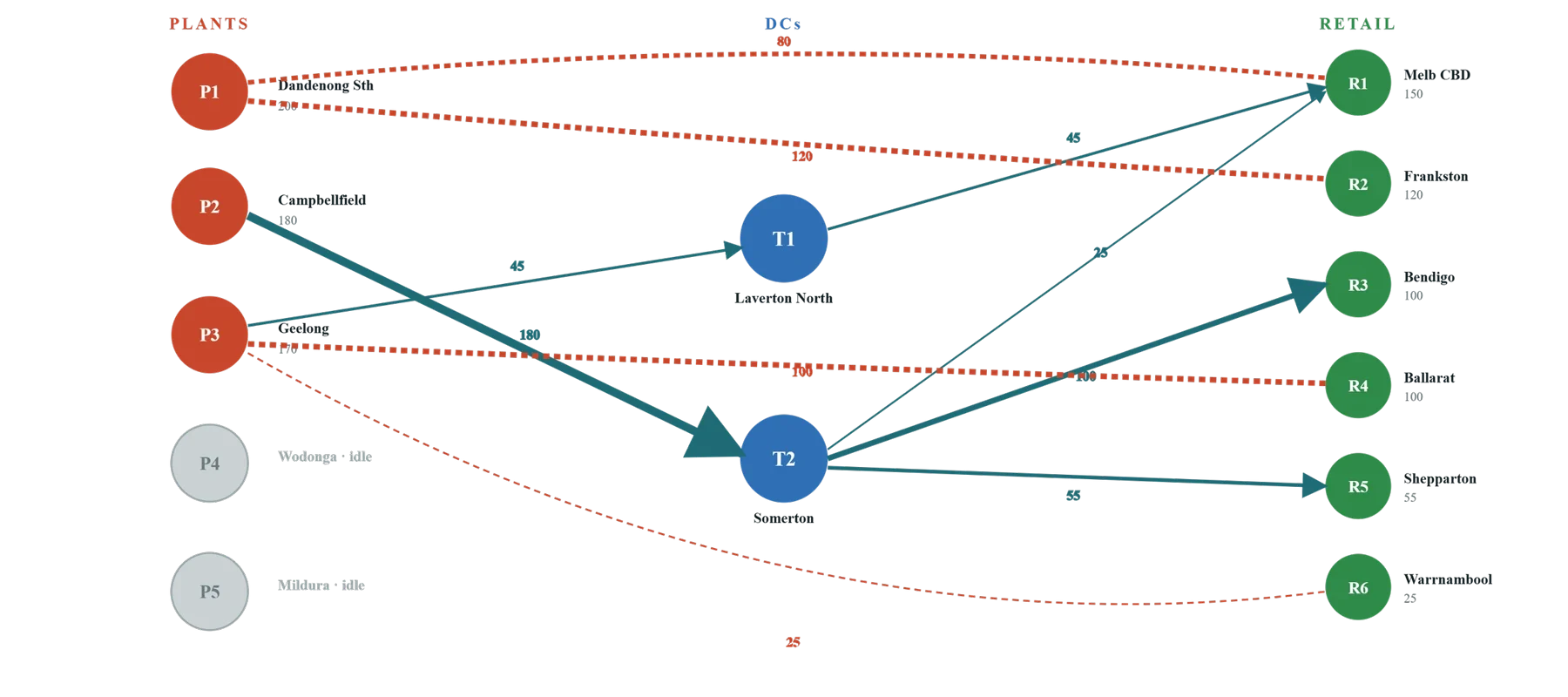
The optimal flow network: arrow thickness shows pallets/week from each plant, through the two DCs, to each retail outlet.
04 — Results
What the data said.
05 — Highlights
At a glance.
- 27 candidate routes
- 10 active in the optimum
- 5 plants · 2 DCs · 6 outlets
- 2-route disruption test
- +9.0% cost under disruption
- Sensitivity analysis