 Nikhil Gupta
08 / 08 · Business Analytics
Alpine Peak Resort
Monte Carlo simulation
Built a 1,000-trial Monte Carlo simulation to test room-rate and overbooking strategy for a 50-room alpine resort, weighing expected profit against downside risk.
$450/night beats $350 by +47.9% profit
 ExcelSimulation
01 — The brief
Problem & outcome.
The problem
The resort's Sales Manager had to set a nightly room rate and an overbooking allowance for peak season, under uncertain booking volume, late cancellations, and daily operating costs, without a reliable way to compare strategies on both expected profit and downside risk.
The outcome
Built a single-day stochastic profit model with four calibrated random inputs (Poisson bookings and walk-ins, Binomial cancellations, Normal costs) and ran 1,000 trials per scenario. $450/night delivered a mean daily profit of $14,442 versus $9,767 at $350, a statistically significant 47.9% uplift.
The $450 strategy with a 5% overbooking limit won on every measure: higher mean profit, non-overlapping 95% confidence intervals confirming the gap is real, and a lower chance of a bad day (0.6% vs 10.5% chance of profit under roughly $9,000). Demand volume, not cost control, turned out to be the dominant driver of profit, by a factor of about ten.
02 — Key numbers
By the numbers.
03 — How it works
The model.
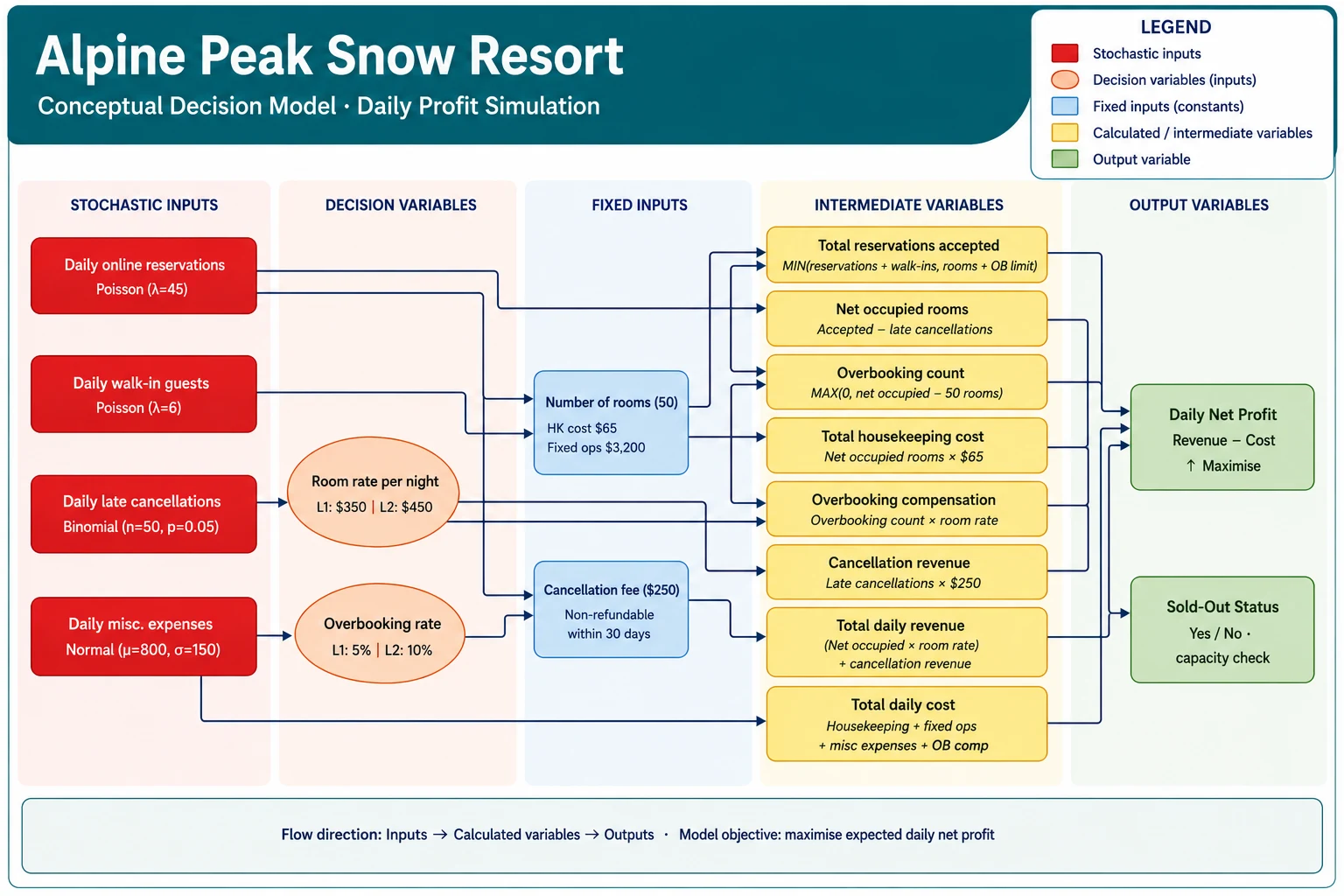
The conceptual decision model: stochastic inputs, decision variables, and fixed inputs flowing through to daily net profit.
04 — Results
What the data said.
05 — Highlights
At a glance.
- 1,000 trials per scenario
- 4 calibrated random inputs
- +47.9% mean daily profit
- Non-overlapping 95% CIs
- 0.6% vs 10.5% bad-day risk
- ~$561K season uplift